


Root canal or extraction: the short answer
If a tooth can be saved, a root canal is usually the better long-term choice: you keep your natural tooth, your bite stays stable and no replacement is needed. Extraction is the better choice when a tooth is cracked below the gum, too broken to restore, or held by too little bone. If a tooth is removed, it should be replaced, usually with an implant or a bridge.
| Root canal treatment | Tooth extraction | |
|---|---|---|
| Keeps your natural tooth | Yes | No |
| Visits | Often one sitting; two if there is infection | Usually one visit |
| Usually needs afterwards | A crown on back teeth | An implant, bridge or denture to fill the gap |
| Effect on nearby teeth | None; the bite stays the same | Neighbouring teeth can drift and the bone can shrink if the gap is left |
| Long-term cost | Usually lower overall | Higher once a replacement is added |
Your dentist decides after an examination and X-rays; a CBCT scan helps in difficult cases.
When a tooth is badly decayed or infected, most patients are offered two choices: save it with a root canal, or remove it. Removal can feel quicker and cheaper on the day, but it is rarely the end of the treatment. This guide explains when each option is the right one, and what to ask your dentist.
When is a root canal the better choice?
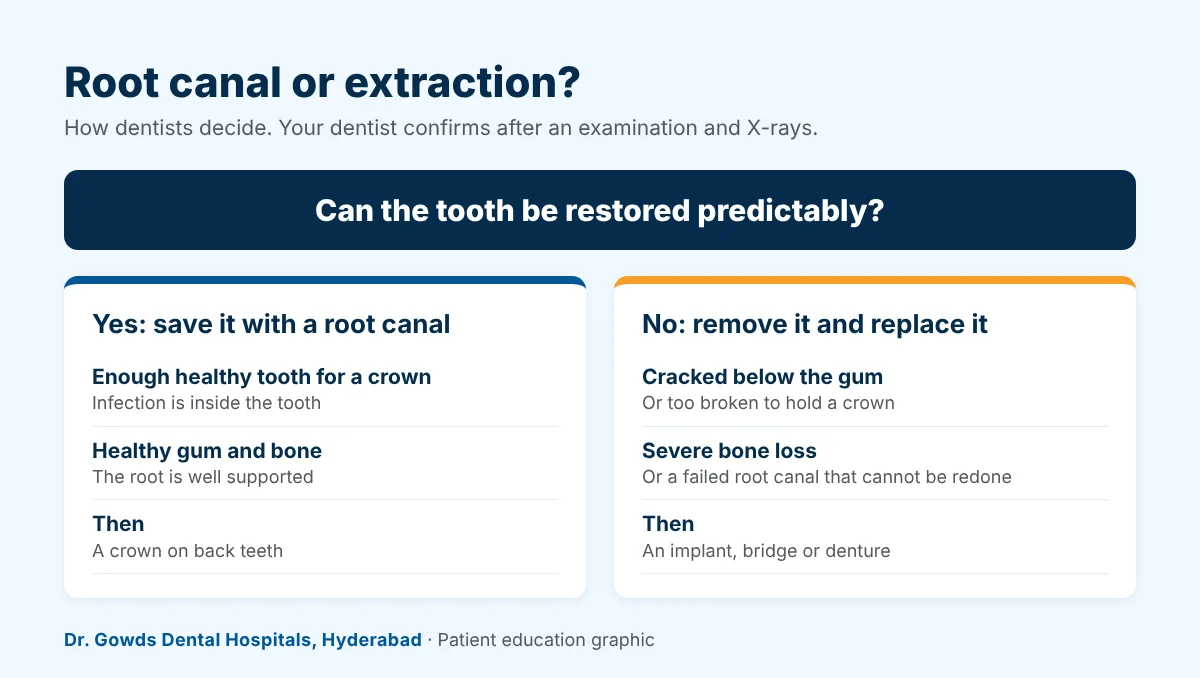
A root canal is the better choice when the infection is inside the tooth but the tooth itself is strong enough to restore and well supported by bone and gum.
- Deep decay or infection that has reached the nerve, with enough healthy tooth left for a crown
- Pain on biting, lingering sensitivity to hot or cold, or a small abscess
- A tooth that matters for chewing or for your smile, such as a molar or front tooth
- Healthy gums and enough bone around the root
Modern root canal treatment is done under local anaesthesia and feels much like a filling. Many are completed in a single sitting. Read more about painless root canal treatment in Hyderabad.
When is extraction the better choice?
Extraction is advised when a tooth cannot be restored predictably, even with a root canal and a crown.
- A crack that runs down the root or below the gum line
- So little tooth left above the gum that a crown cannot be held
- Severe gum disease with loose teeth and major bone loss
- A root canal that has already failed and cannot be redone
- An impacted or badly positioned wisdom tooth that keeps causing problems
Extraction is usually quick and done under local anaesthesia. See our tooth removal guide for what to expect.
What happens if you remove a tooth and do not replace it?
A gap left open causes slow changes that are harder and more costly to fix later.
- Neighbouring teeth tilt into the space, and the opposite tooth can over-erupt.
- The bite changes, which can strain other teeth and the jaw joint.
- The jawbone under the gap shrinks over time, which can mean a bone graft is needed before an implant.
- Chewing moves to one side, and food traps in new gaps.
That is why extraction is usually followed by a replacement: a dental implant, a bridge or a denture. Compare the options in our implants or bridges guide.
Root canal versus extraction: cost over time
On the day, extraction usually costs less. Over time, a root canal with a crown usually costs less than an extraction followed by an implant or bridge, and you keep your own tooth.
For current prices, see our root canal cost guide and the dental implant cost guide. Your exact cost is confirmed after an examination.
Questions to ask your dentist before deciding
- How much healthy tooth is left, and will it hold a crown?
- What do the X-rays or the CBCT scan show about the root and the bone?
- What is the outlook for this tooth with a root canal?
- If it is removed, which replacement do you recommend, and when?
- What is the total cost of each path, including the crown or the replacement?
How Dr. Gowds Dental Hospitals decides
Our dentists aim to save natural teeth whenever it is predictable. Each tooth is assessed with an examination and digital X-rays, and with a CBCT scan where the roots or bone need a closer look. When a tooth cannot be saved, removal and replacement are planned together, under Prof. Dr. Vikas Gowd, Prosthodontist and Implantologist.
Consultations are available at our Banjara Hills, Secunderabad and Hitech City (which also serves Kondapur) branches.
Frequently asked questions
Is it better to have a root canal or pull the tooth?
If the tooth can be restored, a root canal is usually better: you keep your natural tooth and avoid the cost of a replacement. If the tooth is cracked below the gum, too broken or poorly supported by bone, extraction followed by a replacement is the better choice.
Is a root canal more painful than an extraction?
Neither should be painful during treatment, as both are done under local anaesthesia. Mild soreness for a few days is common after either. A root canal relieves the pain caused by the infection inside the tooth.
How long does a root canal-treated tooth last?
With a good seal, a crown where advised and regular check-ups, a root canal-treated tooth can last for many years. Back teeth usually need a crown to protect them from breaking.
Can I just remove the tooth to save money?
You can, but the gap usually needs filling later. Neighbouring teeth drift and the bone shrinks, so an implant or bridge is normally advised. Once a replacement is added, extraction often costs more overall than a root canal and crown.
Do I need a crown after a root canal?
Back teeth (molars and premolars) usually need a crown after a root canal, because they take heavy chewing forces and can crack. Front teeth sometimes only need a filling. Your dentist advises after treatment.
When is a tooth too damaged for a root canal?
A tooth is usually too damaged when it is cracked down the root, broken below the gum line, has very little tooth structure left to hold a crown, or is loose because of severe bone loss.
What is the best replacement after an extraction?
A dental implant replaces the tooth without touching neighbouring teeth and helps preserve the bone. A bridge or a denture are other options. The right choice depends on the bone, the neighbouring teeth, your health and budget.
How soon should a removed tooth be replaced?
It depends on the replacement. Some implants can be placed at the time of extraction; others are placed after a few months of healing. It is best to plan the replacement before or at the time of extraction.
Can a failed root canal be redone?
Often, yes. A root canal can be retreated if the tooth is still strong and the cause of failure can be corrected. If it cannot be retreated predictably, extraction and replacement are discussed.
Can antibiotics cure an infected tooth without a root canal or extraction?
No. Antibiotics can calm swelling for a while, but the infection inside the tooth returns unless the cause is treated with a root canal or by removing the tooth.
Not sure whether your tooth can be saved?
Book a consultation, call your nearest branch or message us on WhatsApp. We will examine the tooth and explain both options, with the cost of each.
Read next: painless root canal treatment in Hyderabad.


