

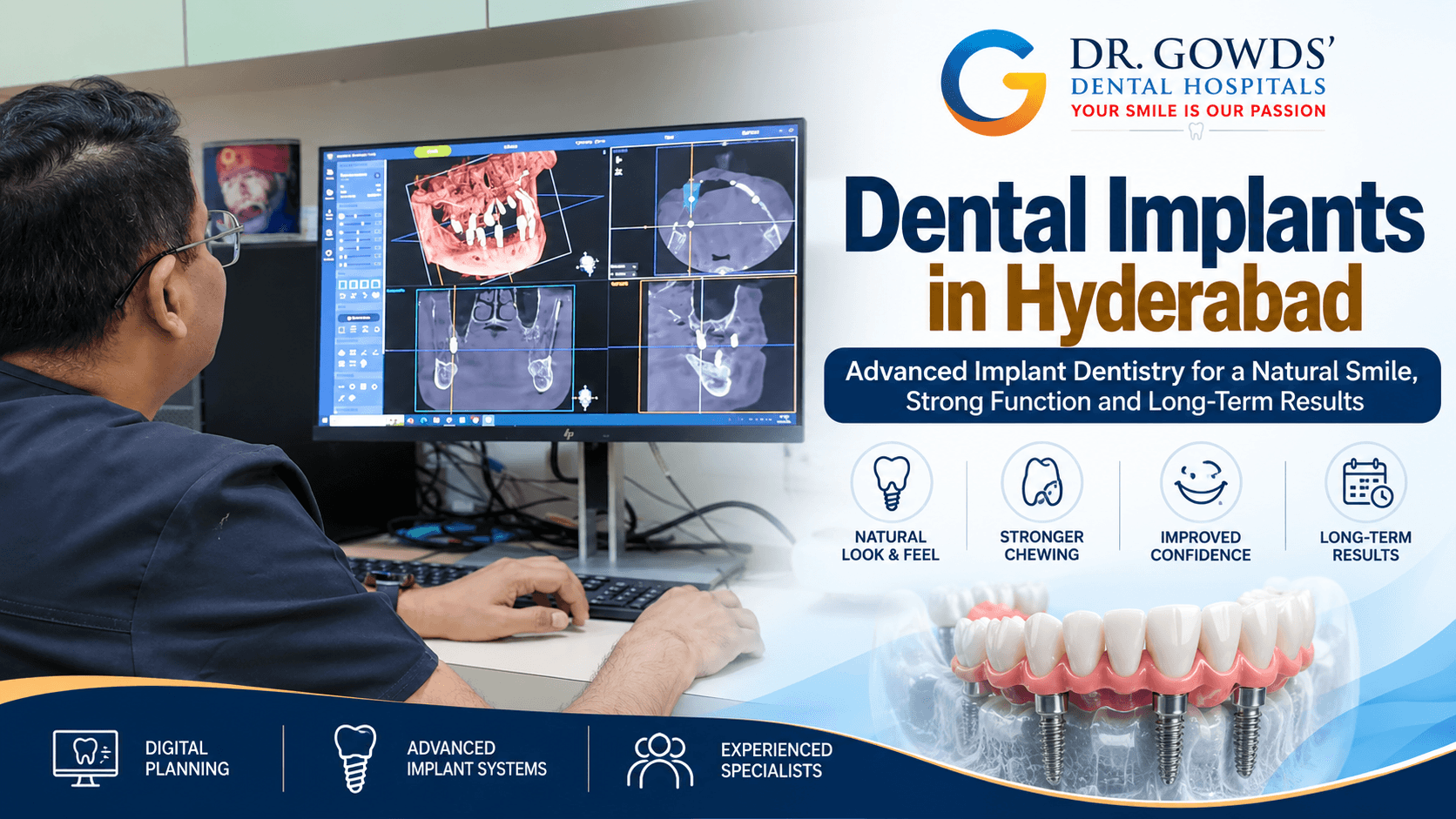
If you have been avoiding smiling because of missing teeth, struggling with loose dentures, finding it difficult to chew because of loose teeth, or simply losing confidence because of your teeth, dental implants can offer a fixed and natural-looking solution.
Modern dental implantology has transformed the way missing teeth are replaced. With appropriate planning and case selection, implants can be used to replace a single missing tooth, several teeth, or an entire arch of teeth.
At Dr. Gowd’s Dental Hospitals, Hyderabad, our approach to dental implant goes beyond simply placing an implant.
We look at the complete picture:
Function. Aesthetics. Speech. Bone. Soft tissue. Bite. Facial proportions. Long-term maintenance.
The objective is not merely to give you implants. It is to restore your mouth to a state where you can eat, speak and smile with confidence.
What Are Dental Implants?
View this post on Instagram
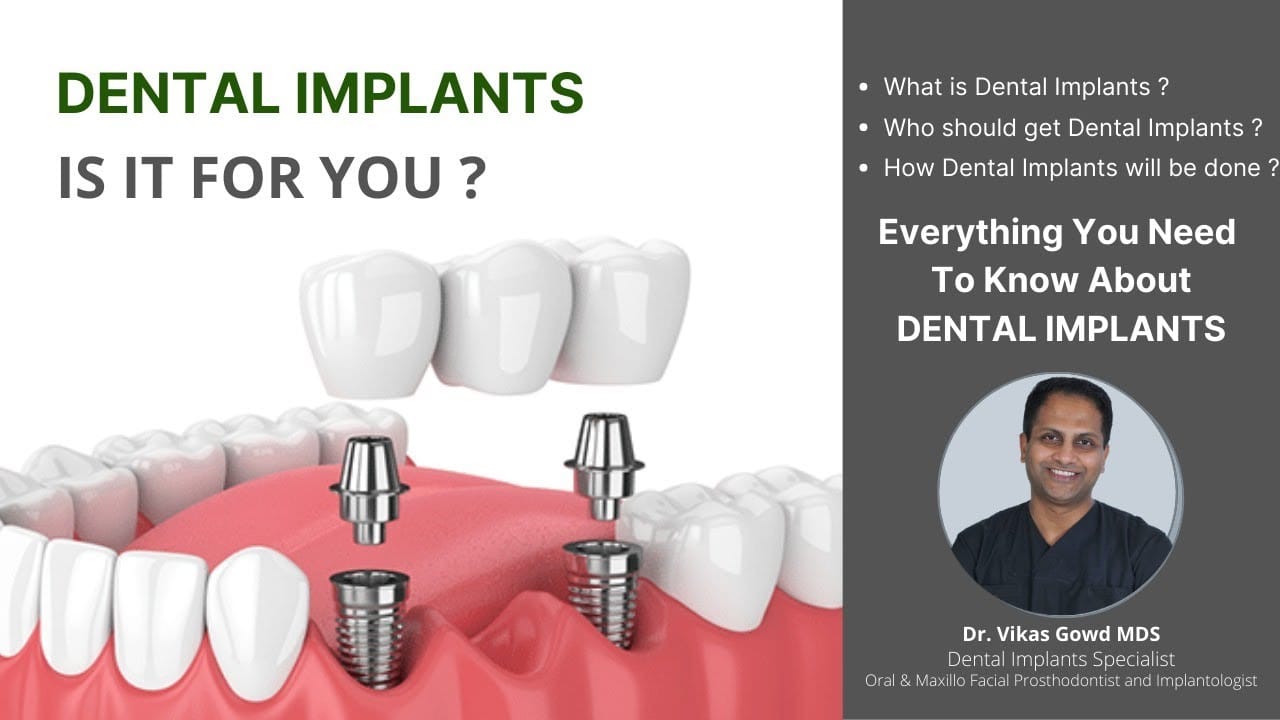
A dental implant is a biocompatible implant fixture that is surgically placed into the jawbone to replace the root portion of a missing tooth.
Once the implant integrates with the surrounding bone, it can support a dental crown, bridge or a fixed full-mouth prosthesis.
Unlike a conventional removable denture, an implant-supported restoration can provide a much more stable foundation for replacement teeth.
Depending on your clinical situation, dental implants can be used for:
- A single missing tooth
- Multiple missing teeth
- Completely missing teeth
- Loose or unstable dentures
- Implant-supported bridges
- Full-mouth fixed teeth
- Immediate implant placement
- Immediate loading in selected cases
- Complex cases with significant bone loss
- Implant-supported full-mouth rehabilitation
- Implant-supported full-mouth rehabilitation
What Do Patients Really Want From Dental Implants?

Interestingly, the priorities of patients and dentists can be quite different.
When a patient comes to us, their first question is often:
“Doctor, how will I look after my treatment?”
And that is completely understandable.
Missing teeth can affect much more than chewing. They can affect the way you smile, speak, socialize and even participate in photographs.
Patients may tell us:
«“I don’t smile anymore.”»
«“I avoid photographs.”»
«“I don’t like going out.”»
«“I can’t eat properly.”»
«“My dentures keep moving.”»
«“I’m worried people will notice my teeth.”»
From a clinician’s perspective, however, we have to look at the entire rehabilitation.
Our priorities include:
1. Function
Can you bite and chew comfortably?
2. Stability
Are the replacement teeth adequately supported?
3. Speech
Will the new teeth allow appropriate tongue movement and phonetics?
4. Aesthetics
Will the teeth complement your face, lips, smile and overall appearance?
5. Long-term maintenance
Can the restoration be cleaned and maintained properly?
The final result has to bring these factors together.
Three Decades of Evolution in Dental Implantology
Implant dentistry has changed dramatically over the last few decades.
When I began working with dental implants, implant treatment commonly involved a considerably longer treatment timeline, with several months between surgical and prosthetic stages.
Today, advances in:
- Implant design
- Surface technology
- Digital diagnostics
- CBCT imaging
- Computer-aided planning
- Guided surgery
- Immediate implant protocols
- Digital impressions
- CAD/CAM prosthetics
- Modern bone-regeneration techniques
- Advanced implant anchorage
- Advanced implant anchorage
have changed what can be achieved in appropriately selected patients.
In selected cases, treatment can now be considerably faster than traditional protocols.
For certain full-mouth cases, immediate or early loading protocols may allow patients to receive a fixed provisional restoration within a short period after implant placement.
However, not every patient is suitable for immediate loading.
The treatment timeline must always be determined after evaluating the patient’s bone, health, bite, implant stability, infection status, prosthetic requirements and overall clinical situation.
The Question Is No Longer Simply “Do Dental Implants Work?”
With decades of experience in implant dentistry, one of the more interesting developments has been the expansion of the situations in which implants can be considered.
The more challenging question today is often:
“What can we do when there isn’t enough bone?”
This is where advanced implant dentistry becomes particularly important.
Many patients are told:
“You don’t have enough bone for implants.”
Sometimes that may indeed be correct for a conventional implant approach.
But inadequate bone does not necessarily mean that every implant-based treatment option is impossible.
The clinician needs to determine:
- How much bone is actually available?
- Where is the available bone located?
- What is the quality of the bone?
- Are there anatomical limitations?
- Can bone be regenerated?
- Can grafting provide the required foundation?
- Can alternative implant positions or anchorage concepts be considered?
- Is a different prosthetic design possible?
This is why complex implant dentistry requires much more than simply knowing how to place an implant.
Dental Implants When Bone Is Insufficient
Bone loss can occur for many reasons, including:
- Long-standing missing teeth
- Advanced periodontal disease
- Previous infections
- Trauma
- Accidents
- Cysts or other pathology
- Previous failed dental treatment
- Long-term denture use
- Natural bone resorption following tooth loss
When a tooth is lost, the surrounding bone can gradually resorb.
In severely resorbed jaws, conventional implant placement may not be straightforward.
Depending on the individual case, treatment may involve:
Bone Grafting
View this post on Instagram
Bone augmentation can be used in selected cases to increase the available foundation for implant placement.
Guided Bone Regeneration
Regenerative techniques can help rebuild deficient areas of bone when clinically appropriate.
Sinus Augmentation
In selected upper-jaw cases, sinus augmentation may increase the available vertical bone height for implant placement.
Advanced Implant Anchorage
In severely resorbed jaws, specially planned implant positions and remote anchorage concepts may sometimes provide alternatives to conventional approaches.
The appropriate technique depends entirely on the patient’s anatomy and treatment requirements.
Advanced Implant Dentistry Is About More Than Placing Implants

A successful implant rehabilitation is not simply:
Bone + Implant = Tooth
There are many more components.
We have to understand:
Bone → Implant Position → Soft Tissue → Bite → Prosthesis → Aesthetics → Function → Maintenance
The implant has to be placed in a position that works for the final restoration.
This is why implant treatment should ideally begin with the final tooth position in mind.
The question should not simply be:
“Where can I put an implant?”
It should be:
“Where should the implant be positioned so that the final tooth functions, looks natural and can be maintained?”
Full-Mouth Dental Implants
For patients who have lost most or all of their teeth, or whose remaining teeth have a poor long-term prognosis, full-mouth implant rehabilitation may be considered.
Depending on the individual anatomy and treatment plan, implants can be used to support fixed teeth.
Treatment may involve:
- Removal of teeth that cannot be predictably maintained
- Infection control
- Implant placement
- Bone regeneration where required
- Immediate or provisional fixed teeth in selected cases
- Definitive digital prosthetic rehabilitation
The objective is to restore the entire oral system rather than simply replace individual teeth.
Immediate Dental Implants and Immediate Loading
One of the major developments in modern implant dentistry is the ability to treat selected patients using immediate protocols.
In appropriate situations, an implant may be placed at the time of tooth extraction.
In selected cases, a provisional tooth or fixed provisional bridge may also be provided soon after implant placement.
However, immediate implant placement and immediate loading are not the same thing.
Immediate implant placement refers to placing an implant at or soon after tooth removal.
Immediate loading refers to placing functional loading on an implant or group of implants within a short period.
Whether immediate loading is appropriate depends on factors such as:
- Primary implant stability
- Bone quality and quantity
- Implant position
- Occlusal forces
- Number of implants
- Prosthetic design
- Patient-specific risk factors
Therefore, immediate treatment should be based on careful diagnosis rather than simply the desire for speed.
Can Dental Implants Look Like Natural Teeth?
Modern implant dentistry is not only about function.
A well-planned implant restoration should also integrate with:
- Your facial appearance
- Lip support
- Gum contours
- Tooth proportions
- Tooth colour
- Tooth position
- Smile line
- Phonetics
This becomes particularly important in the front teeth.
A patient may have an implant that is technically functional but still be unhappy if the final tooth does not look natural.
This is why implant placement and prosthetic planning need to work together.
Restoring More Than Teeth – Restoring Confidence
Some of the most rewarding implant cases are not simply about replacing teeth.
They are about changing what a person feels comfortable doing again.
A person who has avoided photographs for years may begin smiling again.
Someone who has struggled with loose dentures may be able to eat with much greater confidence.
Someone who has hidden their teeth while speaking may become comfortable smiling and communicating again.
In some patients, the final smile can actually look significantly better than the teeth they had earlier in life—particularly when the original teeth were severely irregular, worn, discoloured or damaged.
That is one of the most satisfying aspects of advanced restorative and implant dentistry.
Dental Implants After Trauma and Severe Bone Loss
Trauma and accidents can create some of the most challenging situations in implant dentistry.
A patient may lose:
- Teeth
- Bone
- Gum tissue
- Supporting structures
In these cases, simply placing an implant may not be sufficient.
Treatment may require a combination of:
Bone regeneration + soft-tissue management + implant placement + prosthetic rehabilitation + aesthetic reconstruction.
Advanced regenerative techniques can sometimes allow deficient areas to be reconstructed sufficiently for implant rehabilitation.
The treatment plan must be individualized according to the extent and location of tissue loss.
My Approach to Complex Implant Cases
Over the years, my approach to implant dentistry has evolved from simply replacing missing teeth to looking at the patient as a complete rehabilitation case.
Before recommending implants, I want to understand:
Your medical history
Your general health and medications can influence treatment planning.
Your dental history
Previous extractions, infections, periodontal disease, dentures and failed treatments all provide important information.
Your bone
CBCT imaging can help us evaluate the available bone and important anatomical structures.
Your bite
The forces acting on implants and prosthetic teeth need to be considered.
Your smile
Your smile
Your expectations
A successful treatment plan should address what is important to you—not simply what is technically possible.
From Implant Dentistry to Implant Rehabilitation
There is an important distinction between placing implants and rehabilitating a patient with implants.
Implant placement is a surgical procedure.
Implant rehabilitation is a much broader process.
It involves:
Diagnosis → Planning → Surgery → Healing → Prosthetic Design → Aesthetics → Function → Maintenance
This is particularly important in full-mouth cases.
The implant is only one component of the final result.
Why Experience Matters in Complex Implant Dentistry
Dental implantology has developed enormously over the past few decades.
With experience comes exposure to different clinical situations—not only straightforward cases, but also cases involving:
- Severe bone loss
- Failed implants
- Previously treated jaws
- Trauma
- Complex aesthetics
- Full-mouth rehabilitation
- Immediate loading
- Advanced grafting
- Compromised anatomy
At Dr. Gowd’s Dental Hospitals, implant treatment is approached with the understanding that every patient’s anatomy and goals are different.
My involvement in implant dentistry spans approximately three decades, and since 2006, through the School of Dental Implants, I have also been involved in training dentists in implantology, advanced implantology and grafting procedures.
That teaching experience has reinforced an important principle:
There is no single implant protocol that is appropriate for every patient.
The treatment has to be designed around the individual.
Are Dental Implants Right for You?
Dental implants may be considered if you have:
- One or more missing teeth
- Loose dentures
- Difficulty chewing
- Severely damaged teeth
- Multiple failing teeth
- Completely edentulous jaws
- A desire for fixed teeth
- Significant bone loss requiring advanced assessment
But the right treatment cannot be determined from the number of missing teeth alone.
A proper implant consultation should include a clinical examination and, where indicated, appropriate imaging such as CBCT.
If you are considering dental implants in Hyderabad, an implant consultation should begin with a detailed assessment of your teeth, gums, bone, bite, medical history and aesthetic requirements.
At Dr. Gowd’s Dental Hospitals, implant treatment ranges from single-tooth replacement to complex full-mouth implant rehabilitation and advanced cases involving significant bone deficiency.
The appropriate treatment is determined after individual diagnosis and planning.
Dr. Gowd’s Dental Hospitals
Hyderabad
Advanced Implant Dentistry | Full-Mouth Rehabilitation | Immediate Implant Protocols | Bone Regeneration | Implant Prosthodontics


