

Medically reviewed by Prof. Dr. Vikas Gowd, M.D.S., FICD, FICOI, Implantologist and Prosthodontist, Dr. Gowd’s Dental Hospitals, Hyderabad. Last updated: 12 October 2026.
Full mouth rehabilitation is a planned rebuild of most or all of your teeth, in one or both jaws, to restore a comfortable bite, efficient chewing and a natural-looking smile. In Hyderabad, as anywhere, it usually combines several treatments, such as gum care, root canals, crowns or onlays, dental implants and dentures, delivered in stages over a few months.
This guide explains who needs full mouth rehabilitation, the five stages of treatment, your main options, how long it takes, what affects the cost, and the questions to ask before you start.
What is full mouth rehabilitation?
Full mouth rehabilitation (also called full mouth reconstruction) means treating the whole mouth as one system, not one tooth at a time. The dentist plans how your teeth, gums, bite and jaw joints should work together, then rebuilds towards that plan.
It is often confused with full mouth dental implants, but implants are only one possible part of it. Many patients keep and restore their own teeth.
| Full mouth rehabilitation | Full mouth dental implants | |
|---|---|---|
| What it is | A complete plan to restore all teeth, gums and the bite | Replacing all teeth in a jaw with implant-supported teeth |
| Keeps your own teeth? | Yes, wherever they can be saved | No, it is used when teeth are missing or cannot be saved |
| Treatments involved | Gum care, root canals, crowns, onlays, bridges, implants and/or dentures | Implants plus a fixed or removable full-arch prosthesis |
| Main goal | Healthy, stable bite and function across the whole mouth | Fixed or stable replacement teeth |
If most of your teeth are already missing, read our full mouth dental implants guide for implant-specific details.
Who needs full mouth rehabilitation in Hyderabad?
You may need full mouth rehabilitation when problems affect many teeth at once and routine fillings or single crowns can no longer restore a stable bite. Common reasons include:
- Worn or flattened teeth from grinding (bruxism), acid erosion or long-term wear. The NHS notes grinding can cause worn-down or broken teeth and jaw pain.
- Many broken, decayed or heavily filled teeth.
- Several missing teeth, causing difficulty chewing and drifting of the remaining teeth.
- Failing old crowns, bridges or dentures that are loose, broken or uncomfortable.
- A collapsed bite: worn teeth can lose height, so the jaws close too far. This can strain the jaw joints and make the lower face look shorter.
- Advanced gum disease with loose teeth.
A full examination and scan are needed to confirm whether you need a full mouth plan or only treatment for a few teeth.
What are the stages of full mouth rehabilitation?
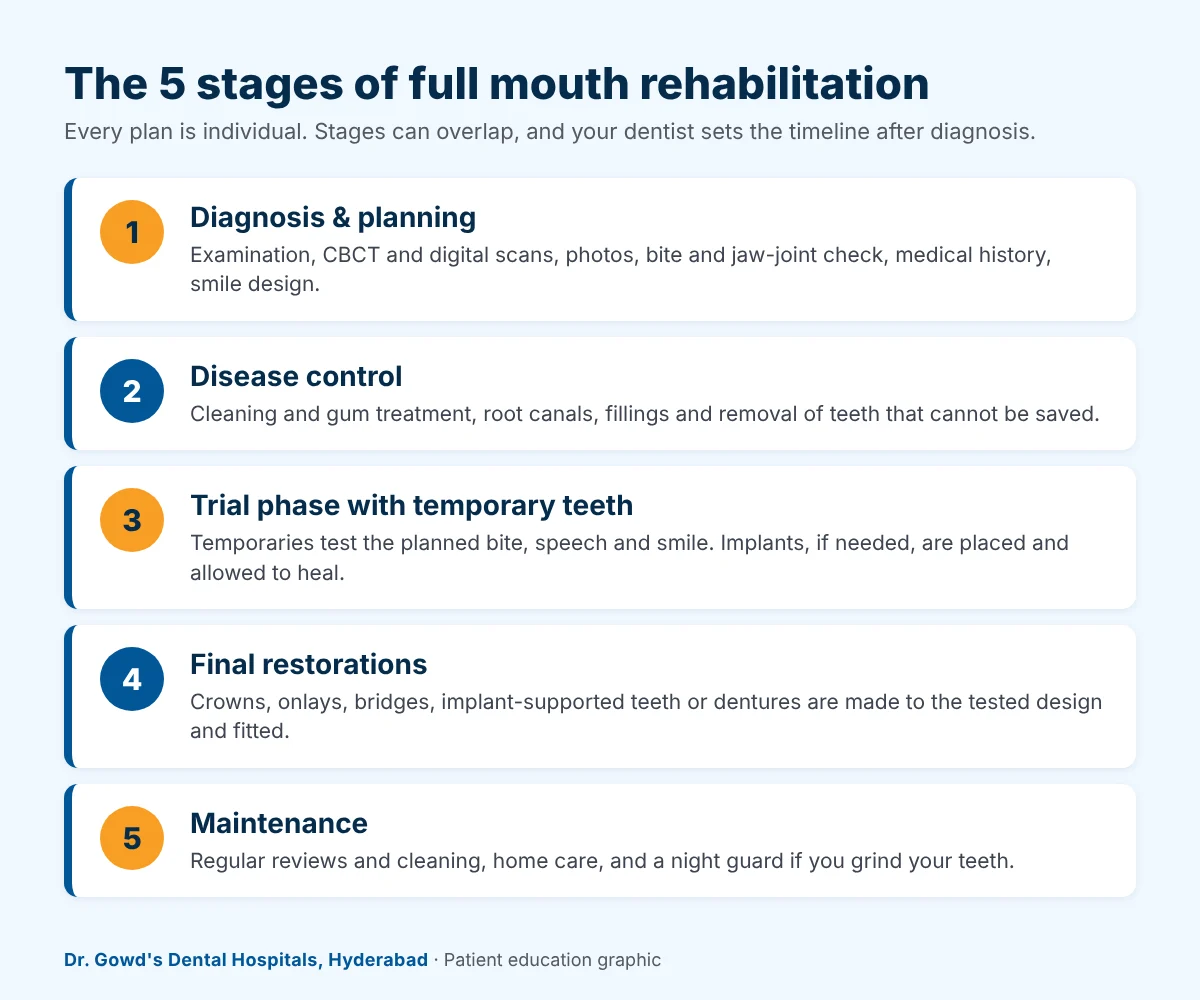
Full mouth rehabilitation usually follows five stages: diagnosis and planning, disease control, a trial phase with temporary teeth, final restorations and maintenance.
1. Diagnosis and planning
The dentist records your medical history, examines your teeth, gums, bite and jaw joints, and takes X-rays or a CBCT (3D) scan, digital scans and photos. Many plans include a smile design or diagnostic wax-up, a model of the planned result, so you can see and discuss it before treatment starts.
2. Disease control
Infection and disease are treated first: cleaning and gum treatment, root canal treatment, fillings and removal of teeth that cannot be saved. Final restorations last longer on a healthy foundation.
3. Trial phase with temporary teeth
Temporary crowns or teeth are made to the planned bite and shape. You wear them for a period, often several weeks, so you and your dentist can check comfort, chewing, speech and appearance before anything permanent is made. Clinical reports describe this testing step as essential for predictable results, especially when the bite height is being restored. If implants are part of the plan, they are placed and allowed to heal during this phase.
4. Final restorations
Once the trial design is confirmed, the final crowns, bridges, onlays, implant-supported teeth or dentures are made, often with digital design and CAD/CAM milling, and fitted. Small bite adjustments are normal.
5. Maintenance
Regular reviews and professional cleaning protect the result. If you grind your teeth, your dentist may advise a night guard (splint). The NHS notes these are worn at night to protect teeth from damage.
What are the treatment options?
Most full mouth rehabilitation plans combine options. The right mix depends on how many healthy teeth and how much bone you have, your bite, your medical history and your budget.
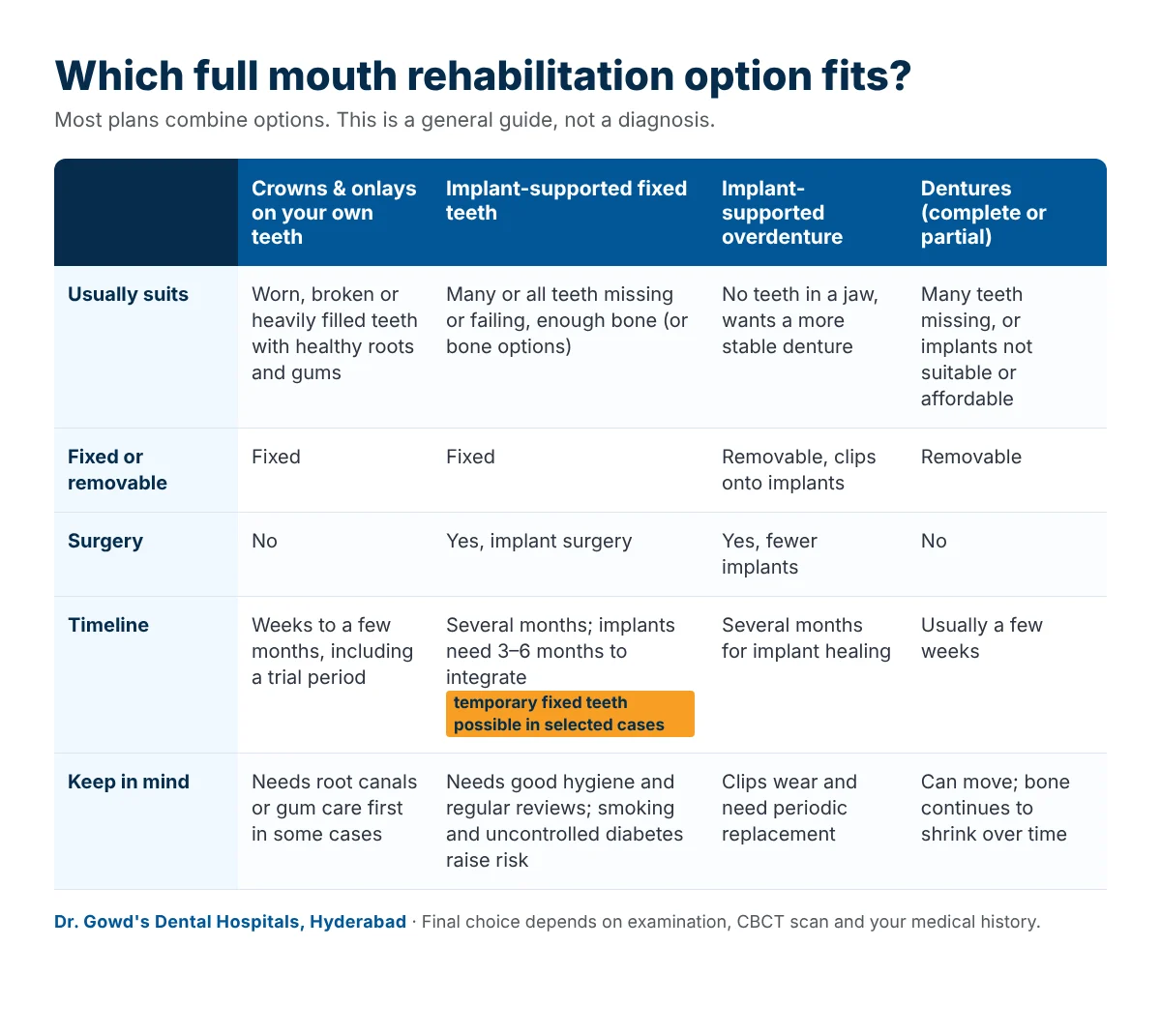
| Option | Usually suits | Fixed or removable |
|---|---|---|
| Crowns and onlays on your own teeth | Worn, broken or heavily filled teeth with healthy roots and gums | Fixed |
| Implant-supported fixed teeth (e.g. All-on-4, All-on-6) | Many or all teeth missing or failing | Fixed |
| Implant-supported overdenture | No teeth in a jaw; wants a more stable denture | Removable, clips onto implants |
| Complete or partial dentures | Many teeth missing, or implants not suitable | Removable |
How long does full mouth rehabilitation take?
Full mouth rehabilitation usually takes a few months and can take longer than a year in complex cases. The timeline depends mostly on whether implants or bone grafting are involved.
| Situation | What affects the time |
|---|---|
| Rebuilding worn teeth with crowns or onlays | Disease control first, then a trial period of several weeks with temporary teeth, then the final restorations |
| Plans that include implants | Implants usually need about 3 to 6 months to integrate with the bone before the final teeth are fitted |
| Immediate fixed temporary teeth | In selected patients with good implant stability, fixed temporary teeth can be fitted within days (see our 72-hour fixed teeth article). It is not suitable for everyone |
| Bone grafting or sinus lift needed | Adds healing time before or after implant placement |
How much does full mouth rehabilitation cost in Hyderabad?
The cost of full mouth rehabilitation in Hyderabad depends on how many teeth need treatment and which options are used, so there is no single price. As an indication, Dr. Gowd’s Dental Hospitals’ published ranges for implant-based full mouth treatment are:
| Treatment | Indicative range |
|---|---|
| Implant-supported overdenture | ₹1,50,000 – ₹3,50,000 per arch |
| All-on-4 dental implants | ₹2,50,000 – ₹6,50,000 per arch |
| All-on-6 dental implants | ₹4,00,000 – ₹8,50,000 per arch |
| Full mouth rehabilitation, both jaws (implant-based) | About ₹4,00,000 – ₹8,00,000 or more |
These are indicative ranges, not quotations. Plans that restore your own teeth with crowns and onlays are priced differently. The final cost depends on:
- The number of teeth needing crowns, onlays, root canals or extractions.
- The number of implants and the implant system used.
- The material of crowns and bridges (for example zirconia or porcelain).
- Extra procedures such as bone grafting, sinus lift or gum surgery.
- Temporary teeth, night guards and follow-up visits.
Always ask for an itemised written estimate after your examination and scan, and check whether it is per arch or for both jaws.
Is full mouth rehabilitation painful?
Treatment is done under local anaesthesia, so you should not feel sharp pain during procedures. Some soreness, sensitivity or swelling for a few days after root canals, extractions or implant surgery is common and is managed with medicines your dentist advises. It can also take a few weeks to get used to a new bite.
What are the risks and limitations?
Full mouth rehabilitation is a major, long-term commitment, and an honest plan should explain its limits:
- Crowns, bridges and dentures can chip, wear or loosen over time and may need repair or replacement.
- Implants need good daily cleaning and regular reviews. Research summarised by the International Team for Implantology links smoking, diabetes and a history of gum disease with a higher risk of peri-implantitis, an infection around implants.
- Bite changes may need fine-tuning after the final teeth are fitted.
- Results depend on attending every stage and maintenance visit.
If you have diabetes, heart disease or take blood thinners, tell your dentist early. Do not stop any medicine without speaking to your doctor.
Questions to ask before you start
- Which teeth can be saved, and why are others being replaced?
- Will I have a trial phase with temporary teeth before the final work?
- Which specialists will be involved: prosthodontist, periodontist, endodontist, oral surgeon?
- Which materials and implant system will you use, and what warranty applies?
- How many visits and months will it take, and what is included in the estimate?
- What maintenance will I need afterwards?
For more on comparing hospitals, see our checklist: 10 things to verify before you book a dental hospital in Hyderabad.
How Dr. Gowd’s Dental Hospitals plans full mouth rehabilitation
- Led by a prosthodontist: plans are overseen by Prof. Dr. Vikas Gowd, M.D.S. (prosthodontics and implantology). Meet our team.
- Specialists under one roof: prosthodontics, implantology, gum care, root canal treatment, oral surgery and orthodontics.
- Digital planning: CBCT imaging, intraoral scanners, CAD/CAM restorations and in-house laboratories.
- Experience since 1967, founded by Prof. Dr. M.S. Gowd.
- Four branches: Banjara Hills, Secunderabad, Hitech City and Kondapur.
Frequently asked questions about full mouth rehabilitation
What is full mouth rehabilitation?
Full mouth rehabilitation is a planned rebuild of most or all teeth in one or both jaws to restore a healthy bite, chewing and appearance. It combines treatments such as gum care, root canals, crowns, onlays, implants and dentures, and is carried out in stages after a full examination and scan.
Is full mouth rehabilitation the same as full mouth dental implants?
No. Full mouth dental implants replace all teeth in a jaw with implant-supported teeth. Full mouth rehabilitation is broader: it restores the whole mouth and keeps your own teeth wherever possible, using implants only where teeth are missing or cannot be saved.
Who is a candidate for full mouth rehabilitation?
People with many worn, broken, decayed or missing teeth, failing crowns, bridges or dentures, a collapsed bite, or advanced gum disease may need it. Your general health, gum condition and bone levels are assessed first. Uncontrolled diabetes or smoking may need to be addressed before some treatments.
How long does full mouth rehabilitation take?
Most cases take a few months, and complex cases can take more than a year. Plans that use implants usually need about 3 to 6 months for the implants to integrate with the bone. A trial phase with temporary teeth, often several weeks, is common before the final restorations.
How much does full mouth rehabilitation cost in Hyderabad?
It depends on the number of teeth treated and the options used. Dr. Gowd’s published indicative range for implant-based full mouth treatment of both jaws is about Rs 4 lakh to Rs 8 lakh or more. Plans that restore your own teeth are priced differently. You get an itemised estimate after examination.
Is full mouth rehabilitation painful?
Procedures are done under local anaesthesia, so you should not feel sharp pain. Soreness or swelling for a few days after surgery, extractions or root canals is common and is managed with medicines your dentist recommends. Getting used to a new bite can take a few weeks.
Can I get fixed teeth on the same day or within a few days?
Some patients receiving implants can have fixed temporary teeth within days if the implants are stable enough. This is decided after a CBCT scan and assessment and is not suitable for everyone. The final teeth are usually fitted after the implants have healed.
How long do the results of full mouth rehabilitation last?
With good home care and regular reviews, results can last many years. Crowns, bridges and dentures may eventually need repair or replacement because of normal wear. Implants need daily cleaning and check-ups to stay healthy, especially if you smoke or have diabetes.
Can full mouth rehabilitation be done if I have diabetes?
Often yes, if your diabetes is well controlled. Your dentist will review your medical history, may coordinate with your physician, and will plan healing time carefully. Diabetes is linked with a higher risk of gum and implant problems, so good control and regular reviews are important.
How many visits will full mouth rehabilitation need?
It needs several visits across each stage: diagnosis and planning, disease control, the trial phase, final fitting and follow-ups. The exact number depends on how many teeth are treated and whether implants or bone grafts are involved. Your dentist should give you a written schedule.
Planning your full mouth rehabilitation
Full mouth rehabilitation works best when it is planned as a whole: diagnosis first, disease control, a tested trial design, then durable final restorations and regular maintenance. Ask for a written plan, a clear timeline and an itemised estimate before you begin.
To discuss your options, book a consultation at any of our four Hyderabad branches or call +91-888 666 4787.
Sources
- Gupta K, et al. Rehabilitation of lost vertical dimension with cast post core and cast partial denture. BMJ Case Reports, 2013
- NHS: Teeth grinding (bruxism)
- International Team for Implantology (ITI): Systemic risk factors and indicators for peri-implantitis, 2024
- Dr. Gowd’s Dental Hospitals: Full mouth dental implants in Hyderabad, cost and complete guide


