

Medically reviewed by Prof. Dr. Vikas Gowd, M.D.S., FICD, FICOI, Implantologist and Prosthodontist, Dr. Gowd’s Dental Hospitals, Hyderabad. Last updated: 10 October 2026.
The best dental hospital in Hyderabad is the one that fits your treatment and passes a few checks you can verify yourself: registered dentists, the right specialist for your problem, visible sterilisation, honest diagnosis and a clear written plan. No ranking or advert can tell you that. A 15-minute check before you book can.
This guide gives you 10 things to verify, how to verify each one, the red flags to walk away from, and the questions to ask at your first visit. It is written for patients in Hyderabad and Secunderabad comparing options for a trusted dental hospital in Hyderabad for implants, braces or aligners, root canals, smile makeovers or family dental care.
Best dental hospital in Hyderabad: the 10-point checklist
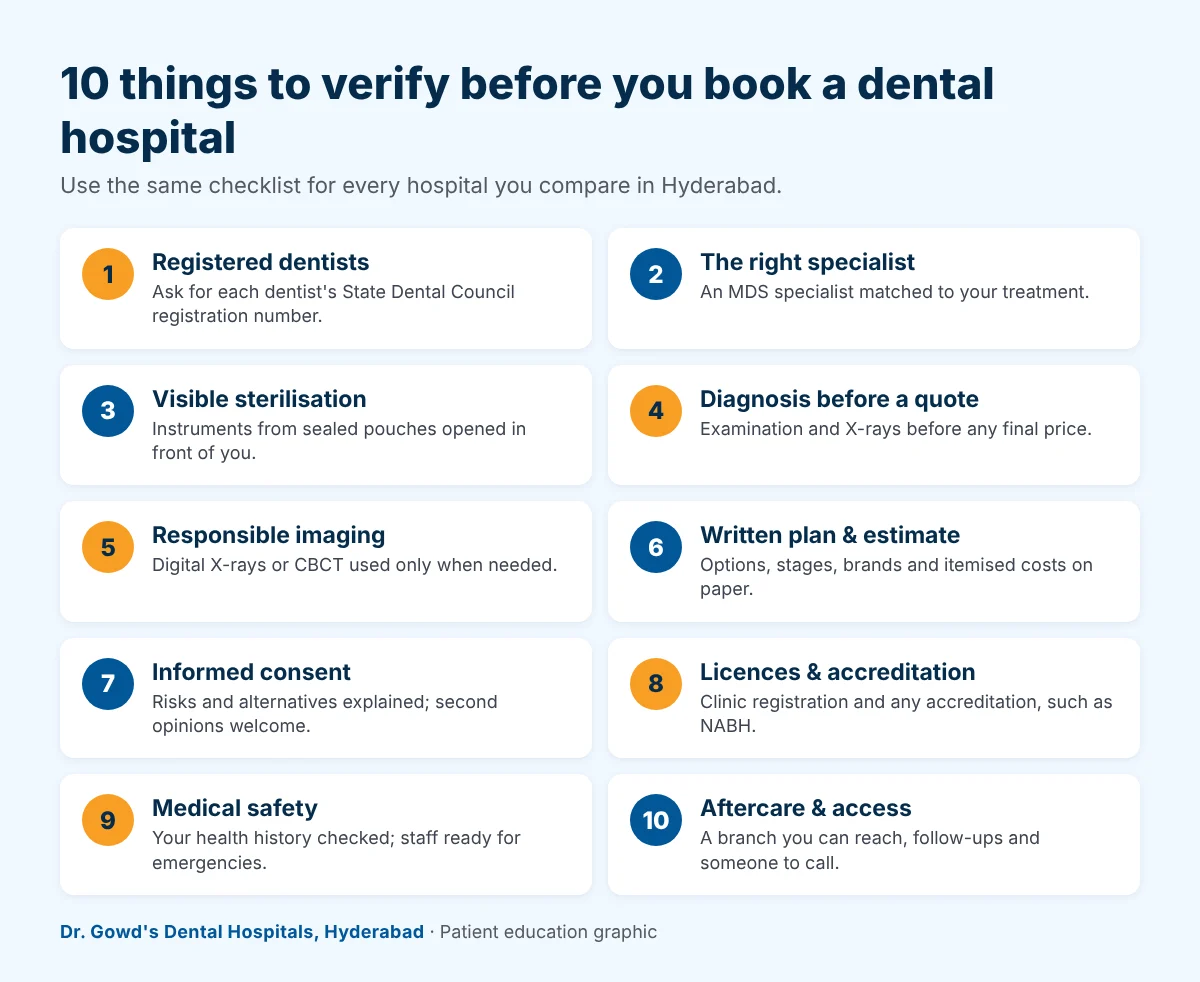
- Registered dentists: every treating dentist is registered with the Telangana State Dental Council.
- The right specialist: an MDS specialist matched to your treatment.
- Sterilisation you can see: sealed instrument pouches opened in front of you.
- Proper diagnosis: an examination and X-rays before any treatment plan or quote.
- Responsible imaging: digital X-rays or a CBCT scan used only when needed.
- A written plan and estimate: options, stages, brands and costs on paper.
- Informed consent: you understand risks and alternatives, and a second opinion is welcome.
- Licences and standards: clinic registrations and any accreditation, such as NABH.
- Medical safety: they take your health history seriously and are ready for emergencies.
- Aftercare and access: a branch you can reach, follow-ups and someone to call after treatment.
1. Are the dentists registered with the dental council?
Every dentist practising in Telangana must be registered with the Telangana State Dental Council, a statutory body set up under the Dentists Act, 1948, which also handles patient complaints and disciplinary action.
How to check: ask for the treating dentist’s full name, qualification and council registration number. A reputable hospital will share it without hesitation, and many display registration certificates in the clinic. If you are unsure, you can contact the council through its website.
2. Will a specialist with the right training treat you?
For anything beyond routine care, ask who will actually treat you and what their specialist training is. A BDS is the basic dental degree. An MDS is a three-year postgraduate specialisation in one branch of dentistry.
A larger dental hospital usually has several specialists under one roof, which matters when a case needs more than one of them. For example, an implant case may need a gum treatment first, and a smile makeover may combine aligners and veneers.
| Your treatment | Specialist to look for | Question to ask |
|---|---|---|
| Dental implants, crowns, bridges, dentures | Prosthodontist or implantologist (MDS) | How many implant cases like mine do you treat, and which implant system do you use? |
| Braces and clear aligners (e.g. Invisalign) | Orthodontist (MDS) | Who plans and monitors my aligner treatment, and how often will I be reviewed? |
| Root canal treatment | Endodontist (MDS) | Will you use a rubber dam and X-rays to check the canals before and after? |
| Gum disease, bleeding gums | Periodontist (MDS) | What is my gum health stage, and what is the maintenance plan afterwards? |
| Wisdom tooth removal, jaw surgery | Oral and maxillofacial surgeon (MDS) | What are the specific risks for my tooth position, and what is the recovery plan? |
| Children’s dental care | Paediatric dentist (MDS) | How do you help anxious children through treatment? |
3. Can you see how instruments are sterilised?
Good sterilisation is something you can see. Instruments should come out of sealed sterilisation pouches opened in front of you, and disposable items such as needles, gloves and suction tips should be single-use.
Infection-control guidance from the US Centers for Disease Control and Prevention (CDC) highlights two common failures: not heat-sterilising handpieces (dental drills) between patients, and not testing steriliser performance (spore testing). It is fair to ask a clinic how it handles both. A confident clinic will be happy to explain, or even show you its sterilisation area.
4. Do they examine and X-ray you before quoting?
A trustworthy hospital examines you and takes the X-rays it needs before recommending a treatment or giving a final price. A quote for implants, aligners or a smile makeover given over the phone, or before an examination, can only be a rough figure. It can change a lot once the dentist sees your bone, gums and bite.
5. Is imaging available and used responsibly?
In-house digital X-rays and CBCT (a 3D dental scan) save time and support accurate planning, especially for implants, impacted wisdom teeth and complex root canals. They should still be used only when they add information.
The American Dental Association advises keeping radiation exposure “as low as reasonably achievable” and using CBCT only when lower-exposure options cannot provide the information needed. In India, X-ray and CBCT equipment must be registered with the Atomic Energy Regulatory Board (AERB). That is one of the compliance items NABH checks in dental clinics.
6. Do you get a written treatment plan and estimate?
Before you agree to major treatment, ask for a written plan. It should cover:
- The diagnosis and the treatment options, including the simplest reasonable option.
- The number of visits and the expected timeline.
- An itemised estimate covering consultation, scans, procedures, materials, lab work and follow-ups.
- The brand or system being used (for example, the implant or aligner system) and any warranty terms.
- What happens, and what it costs, if something needs to be redone.
Prices vary with the case, materials and specialist, so comparing plans line by line tells you far more than comparing headline prices.
7. Do they explain risks and welcome a second opinion?
Informed consent means you understand the benefits, risks, alternatives and cost before you sign. A good dentist explains these in plain language and gives you time to decide. For implants, full-mouth rehabilitation or smile makeovers, getting a second opinion is reasonable, and a confident hospital will not discourage it.
8. What licences and accreditations does the hospital hold?
Ask whether the facility is registered as a clinical establishment and whether it holds any quality accreditation, such as from the National Accreditation Board for Hospitals & Healthcare Providers (NABH), which runs dental-specific standards.
NABH’s dental standards cover infection control, staff credential checks, consent, patient rights, radiation safety, biomedical waste handling, fire safety and emergency preparedness. Accreditation is not mandatory, so its absence is not a red flag on its own. But it is a useful independent signal, and you can verify it on the NABH portal.
9. Are they ready for your medical history and emergencies?
Tell the hospital about any heart condition, diabetes, blood thinners, pregnancy, allergies or recent surgery. A well-run hospital records your medical history, checks it before every procedure, and coordinates with your physician when needed.
Many patients with medical conditions can be treated safely with the right precautions. Do not stop any prescribed medicine on your own before dental treatment; ask your dentist and doctor first. Staff should also be trained in basic life support (BLS), with an emergency kit on site.
10. Can you reach them easily for follow-ups and aftercare?
Implants, braces, aligners and root canals all need several visits, so location and timings matter. Choose a branch near your home or office, check the working hours, and ask who you can call if you have pain or a problem after treatment. Also ask what follow-up visits are included in the estimate.
Red flags: when to walk away
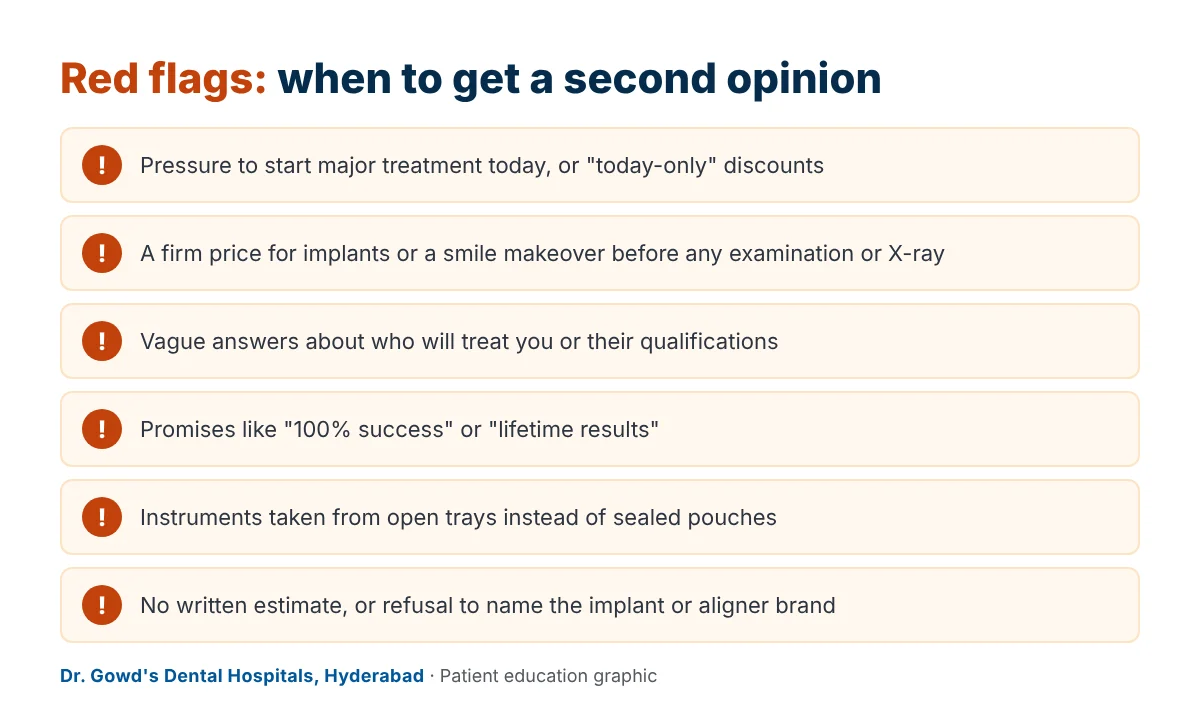
Walk away, or at least get a second opinion, if you notice any of these:
- Pressure to start major treatment the same day, or “today-only” discounts.
- A firm price quoted for implants or a smile makeover before any examination or X-ray.
- Vague answers about who will treat you or what their qualifications are.
- Guarantees such as “100% success” or “lifetime results”. No honest dentist can promise these.
- Instruments taken from open trays instead of sealed pouches.
- No written estimate, or refusal to name the implant or aligner brand.
- Recommending many crowns or veneers when you came in with one small problem, without explaining why.
Do you need a dental hospital or will a clinic do?
For check-ups, cleaning, fillings and simple extractions, a well-run neighbourhood clinic is often enough. A multi-specialty dental hospital makes more sense when your treatment needs several specialists, in-house 3D imaging, or a dental lab, or involves surgery.
| Situation | Neighbourhood clinic | Multi-specialty dental hospital |
|---|---|---|
| Routine check-up, cleaning, small filling | Usually suitable | Suitable |
| Single implant or several implants | Possible if a visiting specialist is available | Usually better: CBCT, specialist and lab under one roof |
| Full-mouth rehabilitation or smile makeover | Limited | Recommended: needs several specialists to coordinate |
| Braces or aligners | Possible with a visiting orthodontist | Suitable, with an in-house orthodontist |
| Impacted wisdom teeth | Depends on surgeon availability | Suitable, with an oral surgeon on the team |
| Patients with complex medical conditions | Depends on setup | Often better equipped |
What to bring and ask at your first consultation
Bring your old X-rays or scans, a list of medicines and medical conditions, and any previous dental treatment records. Then ask:
- Who will treat me, and what is their specialty and registration number?
- What are all my options, including the simplest one?
- Can I have the plan and itemised estimate in writing?
- Which materials or systems will you use, and what warranty comes with them?
- How many visits will it take, and what follow-ups are included?
- What could go wrong, and how would you handle it?
How Dr. Gowd’s Dental Hospitals answers these checks
We wrote this checklist so you can hold every hospital to the same standard, including ours. Here is how Dr. Gowd’s Dental Hospitals, a long-established dental hospital in Hyderabad answers it:
- Experience: founded in 1967 by Prof. Dr. M.S. Gowd and now led by Prof. Dr. Vikas Gowd (implantology and prosthodontics) and Dr. Kirti Gowd (orthodontics). Meet our dental team.
- Specialists under one roof: implants, prosthodontics, orthodontics (braces and Invisalign), root canal treatment, gum care, oral surgery and children’s dentistry.
- Technology: CBCT imaging, digital X-rays, intraoral scanners, lasers, CAD/CAM restorations and in-house laboratories.
- Access: four branches: Banjara Hills, Secunderabad, Hitech City and Kondapur.
- Transparency: ask us for your dentist’s registration details, a written treatment plan and an itemised estimate at your consultation.
Related treatment guides: dental implants in Hyderabad, Invisalign in Hyderabad, root canal treatment and why patients choose us.
Frequently asked questions
Which is the best dental hospital in Hyderabad?
There is no single best dental hospital for everyone. The right choice depends on your treatment, your location and the specialists you need. Shortlist two or three hospitals, check that their dentists are registered, confirm a specialist will treat you, and compare written treatment plans and estimates. The hospital that is open and clear about all of these is usually the safer choice.
How can I check if a dentist in Hyderabad is registered?
Ask the clinic for the dentist’s full name, qualification and Telangana State Dental Council registration number. Registered dentists can share this readily, and many clinics display their certificates. If you have doubts, contact the Telangana State Dental Council, the statutory body that registers dentists in Telangana under the Dentists Act, 1948.
What is the difference between a BDS and an MDS dentist?
BDS (Bachelor of Dental Surgery) is the basic dental degree that qualifies a dentist for general practice. MDS (Master of Dental Surgery) is a three-year postgraduate specialisation in one branch, such as orthodontics, prosthodontics, endodontics, periodontics or oral surgery. For complex treatment like implants, braces or surgery, ask whether the relevant MDS specialist will treat you.
Is a dental hospital more expensive than a dental clinic?
Not necessarily. Cost depends mainly on the treatment, the materials, the brand of implant or aligner, and how complex your case is, not only on the type of facility. A hospital may save you money on complex cases by keeping scans, specialists and lab work in one place. Compare itemised written estimates rather than headline prices.
Should I get a second opinion before dental implants or a smile makeover?
Yes, for major or expensive treatment a second opinion is sensible. Bring your X-rays or scans so the second dentist does not need to repeat them. A trustworthy dentist will welcome the question. Be cautious if a clinic pressures you to decide on the same day or discourages you from consulting anyone else.
Can I get dental treatment if I have heart disease or diabetes?
In most cases, yes, with the right precautions. Tell your dentist about every condition and medicine, especially blood thinners. Your dentist may coordinate with your physician, adjust the timing of treatment, or take extra precautions. Never stop a prescribed medicine on your own before a dental procedure.
Are dental X-rays and CBCT scans safe?
Dental X-rays use low doses of radiation, and modern digital X-rays reduce the dose further. A CBCT (3D) scan gives a higher dose than a regular dental X-ray, so it should be taken only when it adds information needed for treatment, such as implant planning. The American Dental Association recommends keeping exposure as low as reasonably achievable.
Is NABH accreditation compulsory for dental clinics in India?
No. NABH accreditation is voluntary, so many good clinics do not have it. When a clinic does hold it, it shows the clinic has been independently assessed on infection control, patient safety, consent and emergency readiness. You can verify a clinic’s NABH status on the NABH portal rather than relying on a logo.
What should I bring to my first dental consultation?
Bring any previous X-rays or scans, a list of your medicines and medical conditions, and records of past dental treatment. Note your main concerns and questions in advance, such as cost, number of visits and treatment options. This helps the dentist assess you accurately and avoids repeating scans you already have.
How do I know if a dental clinic’s sterilisation is safe?
Watch for instruments taken from sealed sterilisation pouches opened in front of you, and single-use needles, gloves and suction tips. You can also ask how the clinic sterilises handpieces between patients and how it tests its sterilisers. A clinic with good infection control will explain this openly.
Choose with evidence, not adverts
The right dental hospital is the one that can prove its quality: registered specialists, visible sterilisation, careful diagnosis and a written plan you understand. Use the checklist above with every hospital you are considering, including ours.
If you would like a consultation at any of our four Hyderabad branches, book an appointment online or call +91-888 666 4787. Bring this checklist with you, and we will be glad to answer every question on it.


One Response