

Table of Contents
ToggleBy Prof. Dr. Vikas Gowd, M.D.S., FICD, FICOI, DICOI, Prosthodontist and Implantologist, Dr. Gowds Dental Hospitals, Hyderabad. Published: 20 October 2026.
At a glance
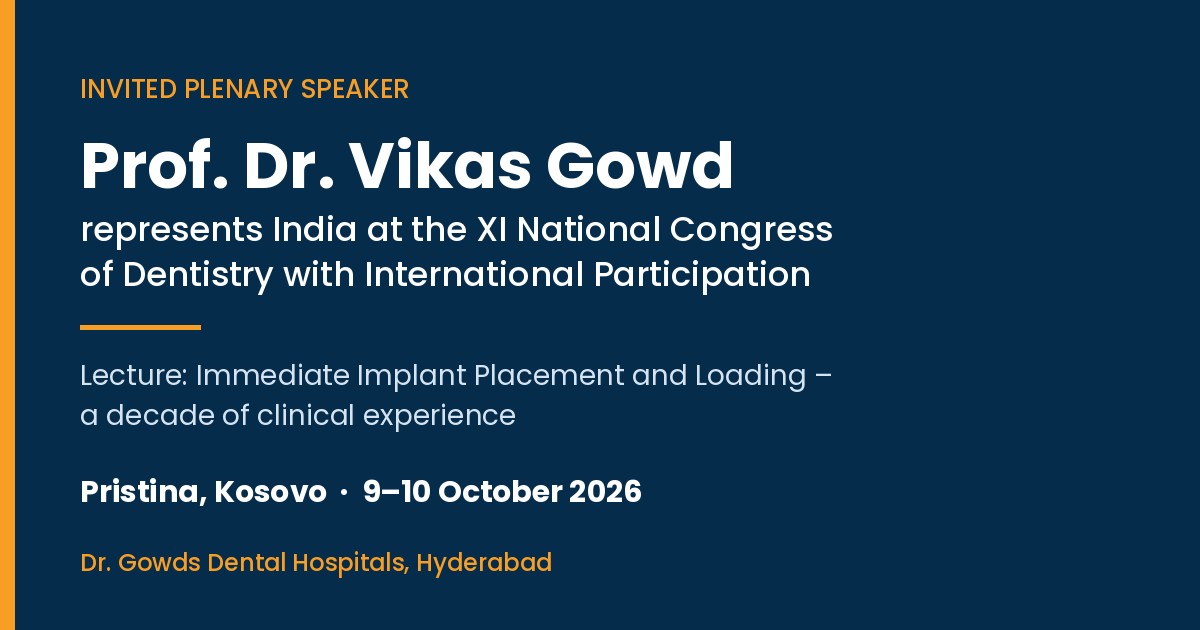
Prof. Dr. Vikas Gowd, Prosthodontist and Implant Specialist at Dr. Gowds Dental Hospitals, represented India as an invited plenary speaker at an international dental congress in Kosovo. His lecture shared a decade of clinical experience in placing implants immediately after tooth extraction and fitting a fixed provisional tooth soon after.
| Event | XI National Congress of Dentistry with International Participation |
| Dates and venue | 9–10 October 2026, Emerald Hotel, Pristina, Kosovo |
| Role | Invited plenary speaker, representing India |
| Lecture | “Immediate Implant Placement and Loading: A Decade of Clinical Experience in the Aesthetic Zone, Posterior Regions and Full-Mouth Implant-Prosthetic Rehabilitation” |
| Who it helps | Patients who need a missing or failing tooth replaced, and dentists learning immediate implant protocols |
Losing a tooth no longer always means months with a gap or a removable denture. For carefully selected patients, an implant can be placed in the same visit as the extraction and a fixed provisional tooth attached soon after. In October 2026, Prof. Dr. Vikas Gowd took this approach to an international audience in Kosovo. This article covers what he presented, and what it means for patients in Hyderabad who are considering dental implants.
What did Prof. Dr. Vikas Gowd present in Kosovo?
He presented clinical protocols for immediate implant placement and loading, built over more than ten years of treating patients in Hyderabad. The lecture covered front teeth, where appearance matters most; back molars, where chewing forces and root shapes make treatment harder; partial tooth loss; and full-mouth rehabilitation.
The focus was on decision-making: how a clinician judges whether a new implant is stable enough to carry a provisional tooth straight away, and when waiting is the safer choice.
About the XI National Congress of Dentistry in Kosovo
The XI National Congress of Dentistry with International Participation was held on 9–10 October 2026 at the Emerald Hotel in Pristina, Kosovo. It brought together dentists, researchers, academics and clinical experts to discuss contemporary dentistry, scientific advances and better patient care.
The opening ceremony was attended by senior representatives of the Government of Kosovo and by the leaders of the dental associations of Kosovo, Albania and North Macedonia. Prof. Dr. Vikas Gowd took part as an invited plenary speaker representing India.
What is immediate implant placement and loading?
Immediate placement means the implant goes into the socket in the same visit the tooth is removed. Immediate loading means a fixed provisional tooth or bridge is attached to the implant soon after, often the same day, instead of after months of healing.
Traditional implant treatment happens in stages, with healing time between extraction, implant placement and the final tooth. Modern implant designs, better surgical planning and a deeper understanding of bone healing have made shorter timelines possible for the right cases.
| Approach | When the tooth goes on | Usually suited to |
|---|---|---|
| Conventional (delayed) loading | After a healing period of several months | Cases where bone or stability needs time; the safest default |
| Early loading | Within days or weeks of implant placement | Good bone but not quite enough stability on the day |
| Immediate loading | A fixed provisional tooth soon after placement, often the same day | Carefully selected cases with strong primary stability and controlled bite forces |
A provisional tooth is temporary. The final crown or bridge is made once the implant has fully joined with the bone. Read more in our guide to immediate loading implants in Hyderabad.
Who can get a fixed tooth soon after extraction?
Only patients whose bone, implant stability and bite allow it. Immediate loading is not suitable for everyone, and the decision is made during planning and confirmed at surgery.
Prof. Dr. Vikas Gowd’s approach centres on five conditions:
- Primary stability: how firmly the implant is held in the bone on the day it is placed.
- Bone quality: the density and volume of bone around the implant.
- Implant position: correct angle and depth, planned in advance from X-rays and 3D imaging.
- The extraction site: the condition of the socket and surrounding gum after the tooth is removed.
- Control of biting forces: designing the provisional tooth so the implant is protected while it heals.
If any of these is not right on the day, allowing extra healing time remains the better choice. A good result matters more than a fast one.
“Patients today value time, but immediate teeth must never mean compromising biology or safety. The objective is to understand the bone, select the right case, achieve appropriate stability and follow a disciplined clinical protocol.”
Prof. Dr. Vikas Gowd
Front teeth, back teeth and full-mouth cases
Immediate implants are planned differently depending on where in the mouth the tooth is missing.
- Front teeth: appearance is the priority, so gum shape and the look of the provisional tooth are planned carefully.
- Back molars: strong chewing forces and complex root anatomy make these harder, and case selection is especially strict.
- Full-mouth rehabilitation: several implants can support a fixed provisional bridge for a whole jaw. See our full mouth rehabilitation guide.
What does this mean for patients in Hyderabad?
Patients who lose teeth to decay, gum disease, trauma or failing dental work may be able to regain their appearance and chewing sooner, if their case is suitable. The first step is always a proper assessment.
- Consultation and examination of the tooth, gums and bite.
- X-rays and 3D imaging to check bone volume and plan the implant position.
- A clear recommendation: immediate, early or conventional loading, with the reasons explained.
- A written treatment plan with stages, timeline and cost before treatment begins.
Learn more about dental implants at Dr. Gowds Dental Hospitals, or read our complete guide to dental implants in Hyderabad.
Taking Hyderabad’s clinical experience to the international stage
Prof. Dr. Vikas Gowd’s lecture adds to the contribution Indian clinicians make to the global exchange of knowledge in advanced implant dentistry. He was the first to place immediate dental implants in the state of Andhra Pradesh, and he is Founder, President and Clinical Director of the School of Dental Implants, Hyderabad, a training institute that teaches dentists implant dentistry.
Through his clinical practice, research and teaching, he aims to help dentists understand when immediate implant protocols can be used, and how careful planning improves the patient experience. His guiding philosophy: Better Awareness. Better Choices. Better Results.
Read his full profile, qualifications and other awards and recognitions on Prof. Dr. Vikas Gowd’s page.
Frequently asked questions
What is the difference between immediate implant placement and immediate loading?
Immediate placement means the implant is put into the socket in the same visit the tooth is removed. Immediate loading means a fixed provisional tooth is attached to the implant soon after, often the same day. A patient can have immediate placement without immediate loading if the implant needs time to heal before it carries a tooth.
Is the tooth fitted on the day of an immediate implant permanent?
No. It is a fixed provisional (temporary) tooth or bridge. It lets you smile and function while the implant heals. Once the implant has fully joined with the bone, your dentist replaces it with the final crown or bridge, made to fit your bite and match your natural teeth.
Why might my dentist advise waiting instead of immediate loading?
Waiting is safer when the implant is not firmly stable on the day, the bone is thin or soft, there is active infection at the site, or biting forces cannot be controlled. Giving the implant extra healing time protects the long-term result, which matters more than saving a few weeks.
Can a back molar be replaced with an immediate implant?
Sometimes. Molars are harder because chewing forces are high and the roots leave a wide socket. Prof. Dr. Vikas Gowd’s protocols include posterior molar sites, but each case is assessed with X-rays and 3D imaging, and immediate loading is used only where stability allows.
Can I eat normally with an immediate provisional tooth?
Not straight away. While the implant heals, your dentist will usually advise softer foods and avoiding hard biting on the new tooth. The provisional tooth is also shaped to reduce the load on the implant. Follow the specific instructions you are given, as they depend on your case.
What was Prof. Dr. Vikas Gowd’s lecture in Kosovo about?
His plenary lecture, “Immediate Implant Placement and Loading”, shared a decade of clinical experience with immediate extraction, implant placement and loading. It covered front teeth, back molars, partial tooth loss and full-mouth implant-prosthetic rehabilitation, with a focus on choosing the right cases safely.
Can dentists learn immediate implant protocols in Hyderabad?
Yes. Prof. Dr. Vikas Gowd is Founder, President and Clinical Director of the School of Dental Implants, Hyderabad, which trains dentists in implant dentistry, including when immediate implant protocols can be applied and how to plan them.
The takeaway
Advances in implant dentistry are making faster tooth replacement possible, but the best outcome comes from choosing the right treatment for each patient. If you have a missing or failing tooth, an assessment will show whether immediate, early or conventional implant treatment is right for you.
Find out if immediate implants suit you
Book a consultation with our implant team, call your nearest branch or message us on WhatsApp.
Read next: immediate loading implants in Hyderabad.


