


Bone grafting before implants: the short answer
A dental bone graft rebuilds jawbone that has shrunk after tooth loss, gum disease or injury, so that a dental implant has enough bone to hold it firmly. Not every implant patient needs one: a CBCT scan shows how much bone there is. A small graft can often be placed at the same time as the implant; a larger one is placed first and allowed to heal for a few months.
| Procedure | What it does | When it is used |
|---|---|---|
| Socket preservation | Fills the socket right after an extraction | To limit bone shrinkage before an implant |
| Ridge augmentation | Rebuilds a jaw ridge that has become thin or low | When bone has shrunk after tooth loss |
| Sinus lift | Adds bone under the sinus floor | For implants in the upper back jaw |
| Graft at implant placement | Adds bone around the implant in one surgery | For small defects |
Bone grafting or a sinus lift, if needed, is added to the implant cost. Your exact plan is confirmed after a CBCT scan.
Many people are told they need a bone graft before an implant and want to know why, whether it hurts and how long it adds to treatment. This guide explains when grafting is needed, the main types, the healing timeline and the alternatives.
Why does jawbone shrink?
Jawbone is kept healthy by the pressure of chewing through the tooth roots. When a tooth is lost, that bone gradually shrinks.
- Tooth loss: the bone under a gap starts to shrink in the first months after extraction and continues over time.
- Gum disease: long-standing infection destroys the bone that supports the teeth.
- Infection or injury: an abscess, a cyst or trauma can leave a defect in the bone.
- Long-term dentures: pressure from a denture on the gums can speed up bone loss.
How do you know if you need a bone graft?
A CBCT scan, a 3D X-ray of the jaw, measures the height, width and density of the bone where the implant will go. Your implantologist uses it to decide whether a graft is needed.
A graft is usually advised when the bone is too thin or too low to hold an implant of a suitable size, or when the upper back jaw has too little bone below the sinus.
Types of dental bone grafts
The type of graft depends on where the bone is missing and how much is needed.
- Socket preservation: graft material is placed in the socket at the time of extraction to limit shrinkage, making a later implant simpler.
- Ridge augmentation: rebuilds the width or height of a jaw ridge that has thinned after tooth loss.
- Sinus lift: gently raises the sinus floor in the upper back jaw and places bone underneath, so implants can be placed there.
- Grafting at implant placement: for small defects, bone is added around the implant during the same surgery.
Graft material can come from your own body, a donor or a synthetic source, and it is often covered with a membrane that protects it while new bone forms. Your implantologist explains which material suits your case.
How long does a bone graft take to heal?
A small graft placed with the implant heals along with it. A larger graft placed before the implant usually needs a few months to mature before the implant can go in.
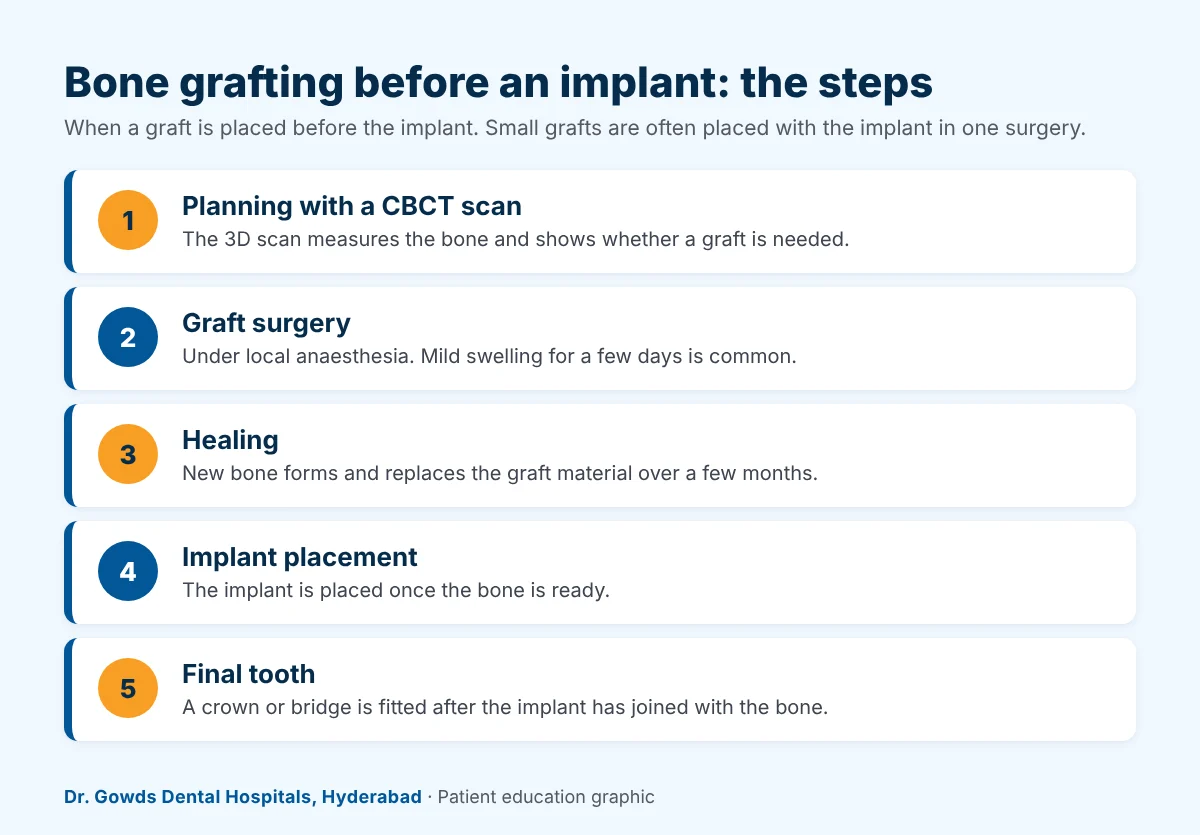
| Step | What happens |
|---|---|
| 1. Planning | Examination and CBCT scan; the graft and implant positions are planned |
| 2. Graft surgery | Done under local anaesthesia; mild swelling for a few days is common |
| 3. Healing | New bone forms and replaces the graft material over a few months |
| 4. Implant placement | The implant is placed once the bone is ready (or at stage 2, for small grafts) |
| 5. Final tooth | A crown or bridge is fitted after the implant has joined with the bone |
Is bone grafting painful?
The procedure is done under local anaesthesia, so it should not hurt. Afterwards, most people have mild swelling and soreness for a few days, which settles with the medicines and care instructions your dentist provides.
- Eat soft, cool foods for the first few days and chew on the other side.
- Do not smoke; smoking slows healing and can cause the graft to fail.
- Avoid rinsing hard or touching the area for the first day.
- Keep every review appointment.
Are there alternatives to bone grafting?
Sometimes. Depending on the bone available, your implantologist may avoid or reduce grafting.
- Shorter or narrower implants where the bone allows.
- Angled implants, as used in All-on-4 treatment, which can avoid grafting in a full jaw. See our full mouth dental implants guide.
- Guided implant surgery, planned on the CBCT scan, which places implants where the bone is best. Read about guided implant placement.
How much does bone grafting add to implant cost?
At Dr. Gowds Dental Hospitals, a single dental implant costs approx. Rs. 25,000 – Rs. 60,000 (depends on case). Bone grafting or a sinus lift, if needed, is added to this, and the amount depends on the type of graft and how much bone is needed.
Your exact cost is confirmed in writing after a CBCT scan. See the full price ranges in our complete guide to dental implants in Hyderabad.
How Dr. Gowds Dental Hospitals plans bone grafting
Implant and grafting cases are planned by Prof. Dr. Vikas Gowd, M.D.S., FICD, FICOI, DICOI, Prosthodontist and Implantologist. He was the first to place immediate dental implants in Andhra Pradesh and the first to conduct a clinical study of bone regeneration from stem cells. Every plan starts with a CBCT scan, so you know before treatment whether a graft is needed and how it changes the timeline.
Implant consultations are available at our Banjara Hills, Secunderabad and Hitech City (which also serves Kondapur) branches.
Frequently asked questions
Do I need a bone graft before a dental implant?
Only if the jawbone is too thin or too low to hold an implant firmly. Many patients do not need one. A CBCT scan measures the bone, and your implantologist decides whether a graft is needed.
Can a bone graft and an implant be done at the same time?
Yes, for small defects. Bone is added around the implant in the same surgery and heals with it. Larger grafts are usually placed first and left to heal for a few months before the implant is placed.
How long after a bone graft can I get an implant?
For a graft placed on its own, the implant is usually placed after a few months of healing, once the new bone is ready. Your implantologist confirms the timing with a follow-up scan.
Is a bone graft painful?
It is done under local anaesthesia, so it should not hurt during the procedure. Mild swelling and soreness for a few days afterwards are common and settle with the medicines and care advice provided.
What is a sinus lift?
A sinus lift adds bone in the upper back jaw by gently raising the floor of the sinus and placing graft material underneath. It allows implants to be placed where the bone would otherwise be too low.
Where does the graft material come from?
Graft material can come from your own body, from a donor or from a synthetic source. It acts as a framework that your own new bone gradually replaces. Your implantologist explains which material suits your case.
Can a bone graft fail?
It can, but it is uncommon when the case is well planned and aftercare is followed. Smoking, infection, uncontrolled diabetes and pressure on the area increase the risk.
What is socket preservation?
Socket preservation means placing graft material in the socket straight after a tooth is removed. It limits bone shrinkage, so that a later implant is simpler and may not need a larger graft.
How much does a bone graft add to the implant cost?
It depends on the type of graft and how much bone is needed. At Dr. Gowds Dental Hospitals, grafting or a sinus lift is added to the implant cost, which starts at approx. Rs. 25,000 – Rs. 60,000 (depends on case) for a single implant.
Can I avoid a bone graft?
Sometimes. Shorter or narrower implants, angled implants as used in All-on-4, and guided implant surgery can reduce or avoid grafting in suitable cases. Your implantologist explains the options after a CBCT scan.
Find out if you need a bone graft
Book an implant consultation, call your nearest branch or message us on WhatsApp. A CBCT scan shows whether you need a graft and how it affects your timeline and cost.
Read next: dental implants in Hyderabad: types, cost and procedure.


