


From advanced ceramic materials and CAD/CAM technology to 3D smile designing and ultra-thin veneers, modern dentistry is making beautiful, natural-looking and minimally invasive smile transformations possible.
A beautiful smile has always been associated with confidence, personality and youth. It is often the first thing people notice when they meet someone. However, what many people do not realise is that behind a beautiful smile lies an interesting combination of science, engineering, material technology and clinical expertise.
Over the last two to three decades, dentistry has undergone a remarkable transformation. What was once considered an elaborate cosmetic procedure has evolved into a sophisticated field combining advanced ceramic materials, digital imaging, computer-aided design and manufacturing, three-dimensional smile simulation and minimally invasive treatment techniques.
One of the most exciting developments in this field is the evolution of ultra-thin ceramic laminate veneers, popularly described as Thineers and, in certain proprietary systems, Lumineers.
Today, these advanced ceramic restorations are changing the way dentists approach smile designing. More importantly, they are changing the way patients understand cosmetic dentistry. It is no longer just about getting whiter teeth or a more attractive smile. In many cases, it is also about restoring worn teeth, protecting vulnerable tooth surfaces, correcting structural imperfections and preserving natural tooth structure.
Beyond aesthetics: dentistry that protects as well as transforms
As we grow older, our teeth undergo years of natural wear and tear. The biting surfaces gradually become flatter, the front teeth may become shorter, enamel can become thinner and, in certain cases, the underlying dentin becomes exposed.
Patients may begin experiencing tooth sensitivity, changes in tooth shape, uneven edges and a loss of the youthful appearance of their smile.
In younger individuals, the concerns may be quite different. Some people have naturally yellow or discoloured teeth, gaps between their front teeth, unusually small teeth, irregular tooth shapes or teeth that are slightly rotated or uneven.
Traditionally, correcting these problems often involved a combination of orthodontic treatment, tooth whitening, bonding or conventional crowns and veneers.
However, advances in adhesive dentistry and ceramic technology have introduced another possibility: ultra-thin ceramic laminate veneers.
These are custom-designed ceramic coverings bonded to the visible surfaces of teeth. Depending on the clinical situation, they can improve tooth colour, shape, size, length and proportions while preserving as much healthy natural tooth structure as possible.
In selected patients with worn or compromised tooth surfaces, appropriately designed ceramic restorations can also help restore lost contours and protect vulnerable surfaces.
The philosophy is simple: a beautiful smile should not come at the cost of unnecessarily sacrificing healthy teeth.
The revolution of ultra-thin ceramic veneers
One of the most remarkable developments in modern aesthetic dentistry is the ability to manufacture extremely thin ceramic restorations with excellent optical properties.
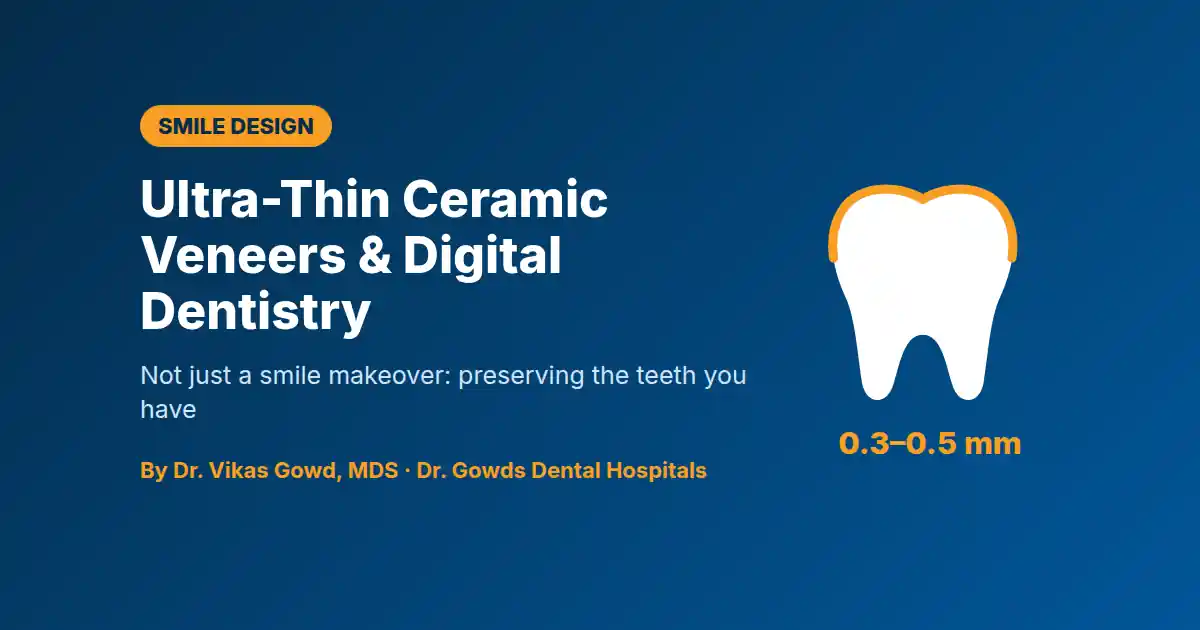
Today’s advanced dental ceramics can be fabricated in thicknesses of approximately 0.3–0.5 millimetres (300–500 microns) in suitable clinical situations. Certain ultra-thin designs can be even thinner.
Thineers and Lumineers: what the names mean
These restorations are popularly referred to as Thineers or ultra-thin veneers. Lumineers is a proprietary name associated with a particular brand of ultra-thin porcelain veneers.
The advantage of these materials is their ability to reproduce the natural appearance of enamel, including its translucency, depth, brightness and light-reflecting properties.
What modern ceramic materials can offer
Modern ceramic materials, including feldspathic porcelain and lithium disilicate, have significantly expanded the possibilities of aesthetic rehabilitation.
Depending on the case, these materials can offer:
- Natural-looking translucency and colour.
- Excellent aesthetic integration with surrounding teeth.
- Resistance to staining.
- Precise restoration of tooth contours.
- The possibility of minimal or no tooth preparation in carefully selected cases.
- Long-term restorative potential when properly planned, bonded and maintained.
Are ultra-thin veneers right for everyone?
However, an important point must be understood: not every patient is suitable for ultra-thin veneers. The remaining enamel, tooth position, bite relationship, available restorative space and the extent of existing damage determine the appropriate treatment.
The objective should always be to select the right ceramic and the right design for the individual patient.
What dental problems can ceramic laminate veneers correct?
Many people assume that veneers are meant only for celebrities or individuals looking for a glamorous smile. In reality, their applications extend to several everyday dental concerns.
- Deeply discoloured teeth: Some stains caused by fluorosis, certain medications, ageing or intrinsic discolouration may not respond adequately to conventional whitening. Ceramic veneers can help mask these stains and create a more uniform tooth colour.
- Gaps between teeth: Spaces between the front teeth, commonly known as diastemas, can affect smile appearance. In suitable cases, veneers can modify tooth proportions and close these spaces without orthodontic treatment.
- Misshapen or unusually small teeth: Patients with peg-shaped lateral incisors, undersized teeth, asymmetrical teeth or unusual tooth contours can benefit from carefully designed ceramic restorations.
- Irregular or slightly crooked teeth: Minor rotations, uneven tooth positions and small alignment discrepancies may sometimes be corrected aesthetically with veneers. Significant misalignment, however, is better managed with orthodontic treatment.
- Worn-out teeth due to ageing: Years of chewing and functional wear can shorten teeth, flatten biting edges and expose dentin. Ceramic restorations can help rebuild lost contours and restore the smile, with the appropriate treatment selected after evaluating the bite.
- Chipped and fractured teeth: Minor fractures, chipped edges and damaged front teeth can be restored to their original appearance using ceramic veneers in suitable cases.
- Old and discoloured dental fillings: Visible composite restorations that have become stained or mismatched can sometimes be replaced with aesthetic ceramic restorations.
- Uneven tooth lengths: Some people have teeth that appear too short, too long or irregularly shaped. Digital planning can help establish more harmonious proportions.
- Black triangles between teeth: Small dark spaces near the gum line may sometimes be improved through carefully designed restorations, depending on the underlying gum and bone condition.
- Complete smile rehabilitation: Patients presenting with a combination of discolouration, gaps, worn teeth, uneven edges and irregular tooth shapes may benefit from comprehensive smile designing.
The important consideration is that veneers are not a universal solution. Some patients may be better treated with aligners, whitening, composite bonding, crowns or a combination of restorative procedures.
From 2D smile designing to 3D digital dentistry
Perhaps the biggest transformation in modern aesthetic dentistry has come through digital technology.
Earlier, smile designing relied largely on photographs, physical impressions, plaster models and two-dimensional computer simulations. Although these techniques were useful, patients often found it difficult to imagine how the proposed smile would actually look in their own face.
Today, digital dentistry has changed this entire experience.
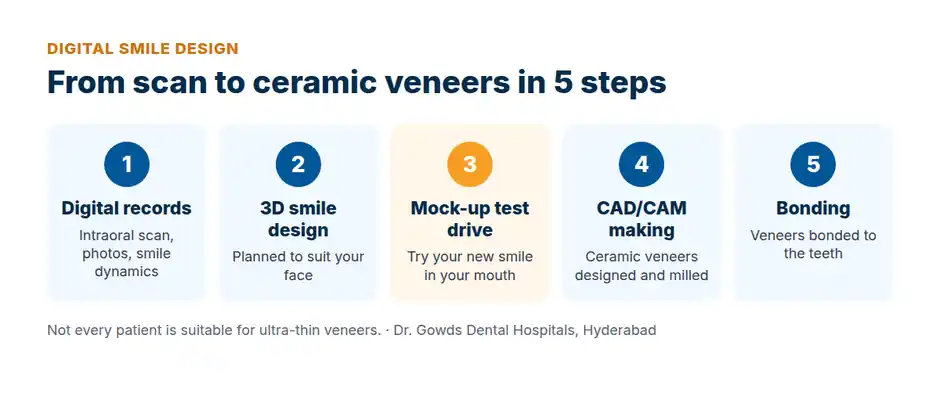
With intraoral scanners, high-resolution photography, advanced smile-design software and CAD/CAM systems, dentists can now create a much more comprehensive digital representation of the patient’s teeth and smile.
The process begins with capturing digital information about the patient’s teeth, facial proportions, lip position and smile dynamics.
This information is then integrated into digital smile-design software, allowing the dentist to evaluate:
- Facial midline and symmetry.
- Tooth length and width.
- Smile line and lip position.
- Tooth proportions and alignment.
- Gingival display.
- Incisal edge position.
- Overall harmony between the teeth and face.
The dentist can digitally modify the proposed tooth shapes, sizes and positions to develop a smile that complements the patient’s facial features.
This is where the combination of digital dentistry and modern engineering becomes particularly exciting.
CAD/CAM: when dentistry meets advanced engineering
CAD/CAM stands for Computer-Aided Design and Computer-Aided Manufacturing.
These technologies, which have transformed industries such as aerospace, automotive engineering and precision manufacturing, have also revolutionised restorative dentistry.
Advanced computer-aided design platforms, sophisticated dental software and precision milling systems allow ceramic restorations to be designed digitally and manufactured with remarkable accuracy.
Engineering principles associated with advanced design platforms, including systems such as CATIA, demonstrate how three-dimensional modelling, surface design and precision manufacturing have influenced modern industrial workflows. In dentistry, specialised dental CAD software translates similar digital design principles into patient-specific restorations.
The digital design is transferred to a manufacturing system, where selected ceramic materials are milled or processed to create the final veneers.
This integration of digital scanning, computer-aided design, material science and precision manufacturing helps improve consistency and control throughout the restorative process.
The result is a much more coordinated approach involving the dentist, dental technician, digital designer and ceramic manufacturing technology.
A test drive of your new smile: the 3D mock-up
Perhaps the most interesting development for patients is the ability to actually experience their proposed smile before the final veneers are made.
This is achieved through a procedure called a diagnostic mock-up or 3D smile trial.
Once the digital smile design is finalised, the proposed tooth shapes and contours are transferred into the patient’s mouth using a specially fabricated silicone index, often called a putty index.
A temporary mock-up material is placed over the teeth to reproduce the proposed smile design.
Now comes the exciting part.
The patient can look into the mirror, smile, speak and experience how the proposed teeth will look in their own face.
It is almost like taking a test drive before buying a car!
Instead of simply looking at a computer-generated photograph and imagining the result, patients get an opportunity to experience the proposed tooth shapes and proportions in real life.
They can discuss whether the teeth look too long, too broad, too prominent or just right. Adjustments can be made to the proposed design based on their feedback and the dentist’s clinical assessment.
Once both the patient and dentist are satisfied with the proposed appearance and function, the treatment can proceed towards the definitive ceramic restorations.
This makes smile designing a collaborative process rather than a decision made entirely by the dentist.
Why is this particularly important for people above 40 and 50?
One of the most promising applications of modern ceramic rehabilitation is in people who have experienced significant tooth wear over the years.
As people enter their forties, fifties and beyond, the effects of ageing may become increasingly visible in their teeth.
Teeth may become shorter, flatter, darker and less symmetrical. The original youthful proportions of the smile may gradually disappear.
Some patients also experience exposed dentin, sensitivity and difficulty maintaining the original appearance of their teeth.
For these patients, the objective is not simply to create a Hollywood smile.
It is to restore the lost tooth anatomy, improve the appearance of the smile, protect suitable vulnerable tooth surfaces and, where required, restore functional relationships.
Depending on the extent of wear, treatment may involve ceramic veneers, onlays, crowns or comprehensive full-mouth rehabilitation.
The emphasis is always on selecting the most conservative treatment that can reliably address the clinical problem.
A combination of science, technology and human artistry
What makes modern smile designing particularly exciting is that no single technology is responsible for the transformation.
It is the combination of several disciplines working together.
Advanced ceramic materials provide the aesthetics and restorative properties. Digital scanners capture accurate information. Smile-design software helps plan the proposed appearance. CAD/CAM systems translate digital designs into physical restorations. Three-dimensional mock-ups allow patients to evaluate the proposed result.
But technology alone cannot create a beautiful smile.
Understanding facial aesthetics, tooth anatomy, occlusion, gum architecture, material selection and adhesive dentistry requires considerable clinical knowledge and experience.
The dentist must understand not just how to make teeth look beautiful, but also how to make them function naturally and remain healthy over time.
This is where the science of prosthodontics and the artistry of aesthetic dentistry come together.
The future of cosmetic dentistry is preservation
The philosophy of modern dentistry is changing.
Earlier, cosmetic dentistry was often associated with extensive tooth reduction and aggressive preparation. Today, the emphasis is increasingly on minimally invasive treatment, digital precision, advanced biomaterials and preservation of natural tooth structure.
At Dr. Gowds Dental Hospitals, we believe that a smile makeover should achieve much more than an attractive photograph.
It should respect the natural tooth structure, restore function, complement facial features and provide a result that patients can comfortably live with.
The evolution of ultra-thin ceramic veneers, advanced CAD/CAM technology, digital smile designing and three-dimensional mock-ups has opened exciting possibilities for patients of different age groups and with different dental concerns.
It has also made the treatment process more transparent, allowing patients to participate in designing their own smiles.
Because sometimes, dentistry is not just about giving someone a beautiful new smile. It is about protecting the teeth they have had for a lifetime, restoring their confidence and helping them smile naturally at every age.
Frequently asked questions
What are ultra-thin ceramic veneers?
They are custom-designed ceramic coverings bonded to the visible surfaces of teeth. Depending on the clinical situation, they can improve tooth colour, shape, size, length and proportions while preserving as much healthy natural tooth structure as possible.
How thin are ultra-thin veneers?
Today’s advanced dental ceramics can be fabricated in thicknesses of approximately 0.3–0.5 millimetres (300–500 microns) in suitable clinical situations. Certain ultra-thin designs can be even thinner.
What is the difference between Thineers and Lumineers?
Thineers is a popular name for ultra-thin veneers. Lumineers is a proprietary name associated with a particular brand of ultra-thin porcelain veneers.
Is everyone suitable for ultra-thin veneers?
No. The remaining enamel, tooth position, bite relationship, available restorative space and the extent of existing damage determine the appropriate treatment. The objective is always to select the right ceramic and the right design for the individual patient.
What dental problems can ceramic veneers correct?
They can help with deeply discoloured teeth, gaps between teeth, misshapen or unusually small teeth, slightly crooked teeth, worn teeth, chipped teeth, old discoloured fillings, uneven tooth lengths, black triangles between teeth and complete smile rehabilitation, in suitable cases.
Can veneers fix crooked teeth?
Minor rotations, uneven tooth positions and small alignment discrepancies may sometimes be corrected aesthetically with veneers. Significant misalignment, however, is better managed with orthodontic treatment.
Can veneers cover stains that whitening cannot remove?
Some stains caused by fluorosis, certain medications, ageing or intrinsic discolouration may not respond adequately to conventional whitening. Ceramic veneers can help mask these stains and create a more uniform tooth colour.
What is a 3D smile trial or mock-up?
It is a way to experience the proposed smile before the final veneers are made. A temporary mock-up material is placed over the teeth using a silicone index, so the patient can smile, speak and see the proposed teeth in their own face. It is almost like taking a test drive before buying a car.
What is CAD/CAM in dentistry?
CAD/CAM stands for Computer-Aided Design and Computer-Aided Manufacturing. The veneers are designed digitally, and the design is transferred to a manufacturing system where selected ceramic materials are milled or processed to create the final veneers.
Are veneers suitable for people over 40 or 50 with worn teeth?
Often, yes. For these patients the aim is to restore the lost tooth anatomy, improve the appearance of the smile and protect suitable vulnerable tooth surfaces. Depending on the extent of wear, treatment may involve ceramic veneers, onlays, crowns or comprehensive full-mouth rehabilitation.
Plan your smile with a 3D mock-up
Book a smile design consultation at Dr. Gowds Dental Hospitals, call your nearest branch or message us on WhatsApp.


